


The Religion & Security Council (RSC) presents the Al-Mashreq podcast, hosted by the Iraqi journalist and analyst Gilgamesh Nabeel. In this episode, entitled “The Psychology of Recruitment: How Narratives Shape the Extremist Mindset”, he interviews Dr. Suha Hassen, an Iraqi-American scholar who earned her PhD at George Mason University and is currently affiliated with the American Public University System (APUS). With more than a decade of field research in Iraq, Dr. Hassen specializes in Islamist jihadist movements, with a particular focus on religiously grounded narratives as drivers of radicalization. Her work includes the development of the Blood Condensation Model, as well as the Body Trap and Temporal Manipulation frameworks. Throughout the conversation, she explores the growing significance of the eschatological discourse in extremist mobilization and explains how narratives shape identity, moral reasoning, and the cognitive processes that can lead individuals toward radicalization.
NARRATIVES AS COGNITIVE FRAMEWORKS
According to Dr. Suha Hassen, narratives should not be understood merely as stories or ideological messages, but as complex socio-psychological systems that shape how individuals interpret reality, construct identity, and make moral judgments. Narratives do not simply describe reality: they actively contribute to creating it. Individuals understand themselves and the world through the stories they internalize, making narratives one of the most powerful instruments for influencing both individual and collective behavior.
From this perspective, narratives are an inevitable component of every society. Every political order, nation-state, or social movement rests upon a foundational narrative that provides legitimacy, historical continuity, and collective purpose. Consequently, narratives are neither inherently positive nor negative. What matters is how they are constructed, by whom they are disseminated, and for what political or ideological objectives they are employed.
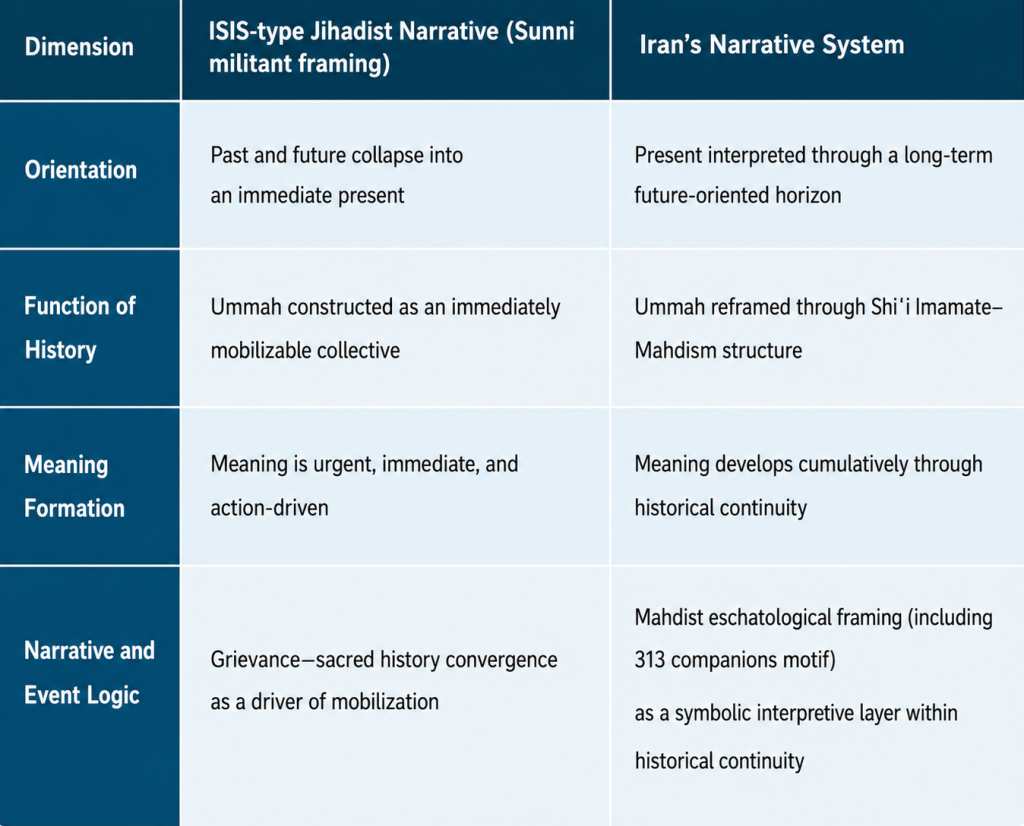
Dr. Hassen explains that the contemporary resurgence of eschatological or apocalyptic narratives is largely a response to increasing levels of uncertainty experienced at both individual and societal levels. Political instability, armed conflicts, economic insecurity, rapid social change, and identity crises generate widespread anxiety and create fertile ground for narratives capable of providing simple and emotionally compelling explanations. In periods characterized by ambiguity and insecurity, individuals increasingly seek certainty, meaning, and moral clarity, preferring straightforward and definitive explanations over complex or ambiguous ones. Eschatological narratives satisfy this psychological need by offering a comprehensive interpretation of reality structured around absolute moral categories such as good versus evil, believers versus enemies, or salvation versus destruction. Dr. Hassen suggests that eschatological narratives function as living entities, sustained through intergenerational transmission. State and non-state actors, such as Iran and ISIS, strategically exploit these narratives to radicalize and mobilize individuals. The table below illustrates how these actors instrumentalize such narratives.
INDIVIDUAL VULNERABILITY AND EXTREMIST NARRATIVES
Individual vulnerability constitutes another essential dimension of Dr. Hassen’s analysis. Susceptibility to extremist narratives does not arise primarily from poverty or political grievances alone, but rather from a combination of psychological and social vulnerabilities. Identity crises, loneliness, social exclusion, uncertainty, lack of belonging, and the search for personal significance all increase receptiveness to narratives promising purpose and recognition. These conditions do not automatically produce radicalization. Instead, they create an environment in which persuasive narratives can become particularly influential.
At the societal level, Dr. Hassen highlights how narratives are frequently employed as instruments of political power. Governments, political elites, and influential actors deliberately construct and disseminate narratives to mobilize populations, reinforce political legitimacy, and shape public perceptions. Eschatological narratives are particularly effective because they present political projects as historically inevitable or morally necessary, thereby reducing space for dissent while legitimizing extraordinary political measures. In this sense, narratives function not only as mechanisms of persuasion, but also as tools of governance and social control.
Central to Dr. Hassen’s argument is the distinction between explaining why radicalization occurs and understanding how it unfolds. Traditional analyses often focus on structural causes such as socio-economic inequality, political repression, or foreign policy grievances. While these factors undoubtedly create conditions conducive to radicalization, they do not explain the cognitive process through which individuals adopt extremist worldviews. According to Dr. Hassen, this transformation occurs primarily through narrative.
Narratives operate as mechanisms that gradually reshape identity, moral reasoning, and behavioral orientation. They influence how individuals define themselves, identify enemies, assign moral responsibility, and interpret historical events. In this sense, narratives function as cognitive architectures that reorganize an individual’s understanding of reality rather than merely communicating ideological content.
NARRATIVES AS MECHANISMS OF RADICALIZATION AND COGNITIVE TRANSFORMATION
An important mechanism discussed by Dr. Hassen is the one whereby effective narratives immerse individuals psychologically within a story, allowing them to perceive themselves as active participants rather than passive observers. Eschatological narratives are especially powerful because they transport individuals either into an idealized historical past – such as the restoration of a lost golden age – or toward an imagined future characterized by redemption, final victory, or divine fulfilment. Once individuals become psychologically embedded within these narratives, their perception of present reality becomes filtered through the narrative itself.
Dr. Hassen further distinguishes between cognitive radicalization and behavioral radicalization. Individuals may undergo profound ideological transformation without necessarily engaging in acts of violence. Extremist beliefs, absolutist thinking, and hostile worldviews can exist independently from violent behavior. However, cognitive radicalization creates latent vulnerability. Under favorable conditions – such as exposure to mobilizing rhetoric, social reinforcement, or direct incitement – individuals who have already internalized extremist narratives may become willing to translate beliefs into violent action.
Language plays a particularly significant role throughout this process. Radicalization becomes visible through changes in discourse long before violence occurs. Increasing use of absolutist language, rigid moral categories, dehumanizing expressions, and exclusionary rhetoric reflects deeper cognitive transformations. Consequently, discourse analysis represents an important methodological tool for identifying early stages of radicalization.
Closely related to this linguistic transformation is the process of “othering”. Extremist narratives systematically divide society into morally opposed groups by constructing clear distinctions between “us” and “them”. This process gradually evolves from simple differentiation to moral delegitimization and eventually to dehumanization, which may lead to large-scale violence.
A DYNAMIC PROCESS: NARRATIVE, IDENTITY, AND EXTREMIST MOBILIZATION
Importantly, Dr. Hassen rejects linear models of radicalization. Rather than progressing through predictable sequential stages, radicalization should be understood as a dynamic and multidimensional process involving the interaction of numerous variables. Political grievances, personal vulnerabilities, social networks, ideological narratives, and contextual circumstances continuously reinforce one another. Dr. Hassen compares radicalization to a puzzle whose individual pieces interact in complex and non-linear ways. Nevertheless, she identifies narrative as the initial catalyst capable of activating these broader processes.
The universal nature of narrative further explains its effectiveness. Although languages and cultural contexts differ considerably across societies, the cognitive mechanisms through which narratives influence identity and behavior appear remarkably consistent. This universality enables extremist narratives to spread rapidly across geographical, cultural, and religious boundaries, particularly through contemporary digital communication platforms.
Dr. Hassen also distinguishes between the dynamics operating in the Middle East and those characterizing Western societies. In the Middle East, prolonged conflict, political instability, economic hardship, and collective insecurity provide favorable conditions for eschatological narratives. In Western countries, by contrast, radicalization more frequently emerges among individuals experiencing identity fragmentation, particularly second-generation immigrants who often perceive themselves as belonging fully neither to their country of residence nor to their ancestral homeland. Extremist organizations exploit precisely this search for identity and belonging by offering clear collective identities, purpose, recognition, and community.
FROM NARRATIVES TO COUNTER-NARRATIVES: RETHINKING RADICALIZATION PREVENTION
Finally, Dr. Hassen emphasizes that successful extremist recruitment addresses fundamental psychological needs, rather than merely communicating ideology. Radicalization emerges through the interaction of three elements: the individual’s search for personal significance, a persuasive ideological narrative capable of satisfying that search, and a supportive social network that reinforces both beliefs and behavior. Online platforms and social media have dramatically amplified this process by allowing extremist groups to disseminate narratives globally, create virtual communities, and strengthen emotional identification among geographically dispersed individuals.
Dr. Hassen’s analysis suggests that extremism should be understood primarily as a process of cognitive transformation, and not simply as the product of structural grievances. Narratives constitute the central mechanism through which identities are reconstructed, moral frameworks redefined, and behavior gradually redirected. Understanding the architecture and dynamics of narratives is essential not only for explaining radicalization, but also for designing more effective strategies of prevention, resilience, and counter-narrative development.