

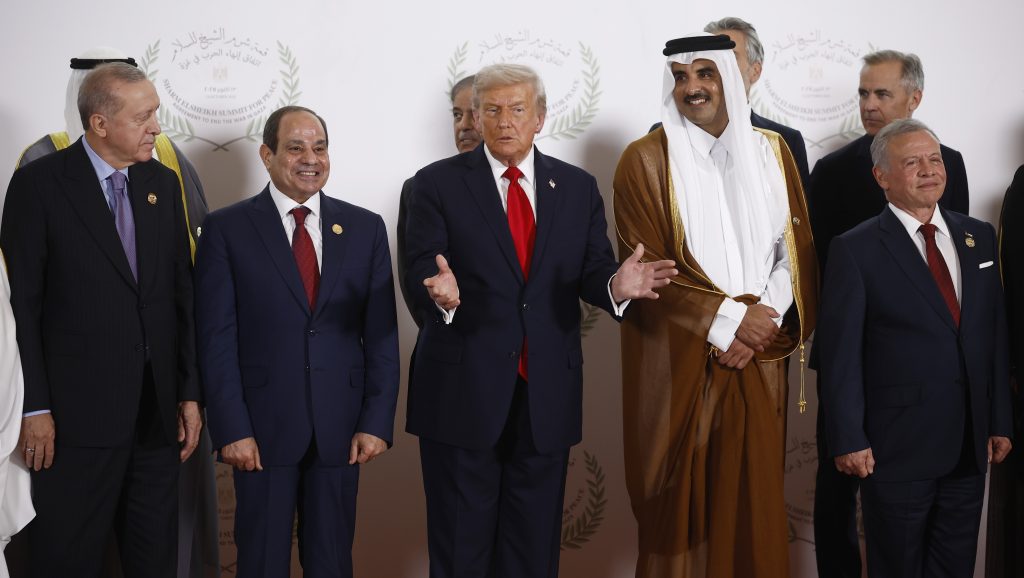
The 20-point “peace” plan between Israel and Hamas concerning the Gaza Strip, endorsed on October 8, 2025, represents a significant, yet precarious, milestone in the ongoing conflict that began on October 7, 2023. The text, brokered by Qatar, Egypt, and the United States, provides a complex framework designed to de-escalate tensions and pave the way for a more durable resolution. However, its implementation is fraught with challenges, largely due to its ambiguous nature and the divergent strategic interests of the key actors.
THE UNCERTAINTIES AFTER “PHASE ONE”
The “peace plan” is structured as a multi-phase arrangement. The first phase, which is so far the only part Israel and Hamas have committed to, is detailed and concrete. It mandates a temporary ceasefire and the release of the 48 remaining Israeli hostages (20 living and 28 deceased), in exchange for approximately 2,000 Palestinian prisoners (of which 1,700 detained after October 7, 2023) and a partial withdrawal of Israeli forces from sectors of the Gaza Strip, along with the facilitation of humanitarian aid corridors.
Beyond “Phase One”, the plan becomes more generic and ambiguous. Subsequent stages outline the implementation of robust security measures, including the complete disarmament of Hamas and other militant groups, the dismantlement of their military infrastructure, and the establishment of an internationally backed Palestinian apolitical governance structure. These later phases also include the deployment of a vetted Palestinian police force, supported by Egypt and Jordan, and significant efforts toward economic reconstruction.
The fact that Israel’s cabinet approved only the first phase underscores its primary interest in securing the release of hostages, leaving the long-term, more contentious elements of the plan in a state of uncertainty. This selective endorsement reflects a strategic preference to address immediate priorities while renouncing the other commitments, given Israel’s evolving security paradigms.
The agreement subtly embodies the divergent strategic visions between the United States and Israel, especially under the Trump administration’s pragmatic deal-making ethos and Prime Minister Netanyahu’s insistence on unilateral maximalism. The Trump’s administration has heralded the pact as a “historic achievement” in terminating protracted conflicts, favoring symbolic diplomatic milestones over rigorous enforcement.
Conversely, Netanyahu’s stance, articulated in his October 5, 2025, Knesset address demanding “total victory”, reflects domestic imperatives for decisive outcomes amid mounting pressure from his coalition government and ongoing legal challenges. This misalignment has previously surfaced in incidents such as Israel’s June 2025 “Rising Lion” airstrikes on Iranian nuclear facilities, which pre-empted US-Iran negotiations, and the September 2025 targeted operation against Hamas figures in Doha, which temporarily strained US-Qatari relations and undermined its broader mediation efforts.
SIMILARITIES AND DIFFERENCES WITH LEBANON’S CASE
The Gaza ceasefire agreement shares a number of characteristics with the November 2024 cessation of hostilities agreement between Israel and Hezbollah, but also presents significant differences.
The primary distinction lies in the scope and detail of the agreements. Hezbollah fully accepted the entire November 2024 plan, which was quite detailed, particularly concerning disarmament efforts in southern Lebanon. In contrast, Hamas and Israel have left the implementation of the Gaza’s “peace” plan future-oriented chapters as a largely aspirational framework.
At the same time the two agreements reveal tactical similarities, notably in the use of a strategy of “calibrated compliance”. Like Hezbollah, which has leveraged initial concessions to defer core commitments like full disarmament and to intensify its recovery endeavors, Hamas is expected to use the first phase of the agreement to relieve military pressure and retain whatever is left of its operational capabilities. Hezbollah’s success in delaying the implementation of later phases in Lebanon, despite significant achievements in dismantling large components of the party’s military infrastructure in Southern Litani, provides a potential blueprint for Hamas. Both organizations exploit the structural weaknesses of their respective governing bodies, as well as grass-root and external support to maintain their political and military standing.
TOWARD “ROUND TWO”?
The vague nature of the Gaza plan allows Hamas and Israel to frame the agreement in a way that aligns with their core interests.
For Hamas, the agreement is framed as a “victory” that allows it to survive militarily and politically. The subsequent stages, which vaguely call for the complete dismantling of its military infrastructure and its exclusion from any future governance structure, represent an existential threat. Hamas’s political survival hinges on its ability to leverage the provision of public services and its armed wing to maintain loyalty. Thus, it is highly unlikely for the organization to willingly comply with the longer-term arrangements, preferring instead to exploit the ambiguities to its advantage.
Israel’s position is shaped by a doctrine that prioritizes the total dismantlement of hostile groups and the establishment of demilitarized buffer zones, while retaining freedom of action against any potential threat in the neighboring countries. The Israeli military establishment has declared that any resurgence of Hamas’s military infrastructure is a red line that will trigger an immediate response. The focus on securing the release of hostages in the first phase reflects the immediate priority, but the broader strategic goal remains the full demilitarization of Gaza at any price.
POSSIBLE SCENARIOS AND CONSEQUENCES ON EGYPT
The fragile nature of the Gaza plan presents two main scenarios. The first envisions a full implementation of the agreement, where all parties fulfill their commitments, leading to a de-escalation of violence and a long-term resolution. This outcome, however, appears highly unlikely given the deep-seated mistrust and the conflicting strategic imperatives between Israel and Hamas.
The second scenario sees the agreement as a tool of delaying tactics, with a high chance of violence resuming. Hamas will probably dispute verification mechanisms and cite Israeli actions as breaches, while Israel will exploit the plan’s ambiguities for targeted “grey zone” operations. Without internationally enforced, verifiable disarmament, the cycle of violence is likely to persist, albeit at varying intensity.
The partial or complete implementation of the agreement will have profound economic, humanitarian, and security impacts on the region, above all on Egypt.
Egypt’s involvement (together with Jordan) in reconstituting a non-partisan police force and a potential international stabilization force is a double-edged sword. While it grants Egypt significant political capital as a regional stabilizing actor, a failure to implement the agreement successfully could reverse these gains. A resumption of violence, fueled by the reluctance of Hamas and Israel to commit beyond phase one, would have direct consequences for Egypt’s security, particularly along its border with Gaza. The humanitarian and security crisis would likely spill over, further straining Egypt’s resources.
SHORT-TERM RESPITE, BLEAK HORIZONS
A partial implementation of the “peace” plan would provide some temporary humanitarian relief and economic aid, but the lack of a comprehensive framework for reconstruction and governance would perpetuate instability in the Gaza Strip. The risk of external interference and escalation spirals would remain high, hindering long-term impact. Conversely, a full-scale collapse of the agreement and a resumption of hostilities would lead to an acute humanitarian crisis and further devastation, with ripple effects across the region.
While politically expedient from Trump’s administration, the 20-point plan perpetuates rather than resolves the fundamental incompatibilities between Hamas’s survival imperatives and Israel’s security doctrines. Without credible international enforcement mechanisms and genuine commitment from both parties to move beyond “Phase One”, the agreement risks becoming another temporary pause in a protracted conflict rather than a pathway to durable peace.