

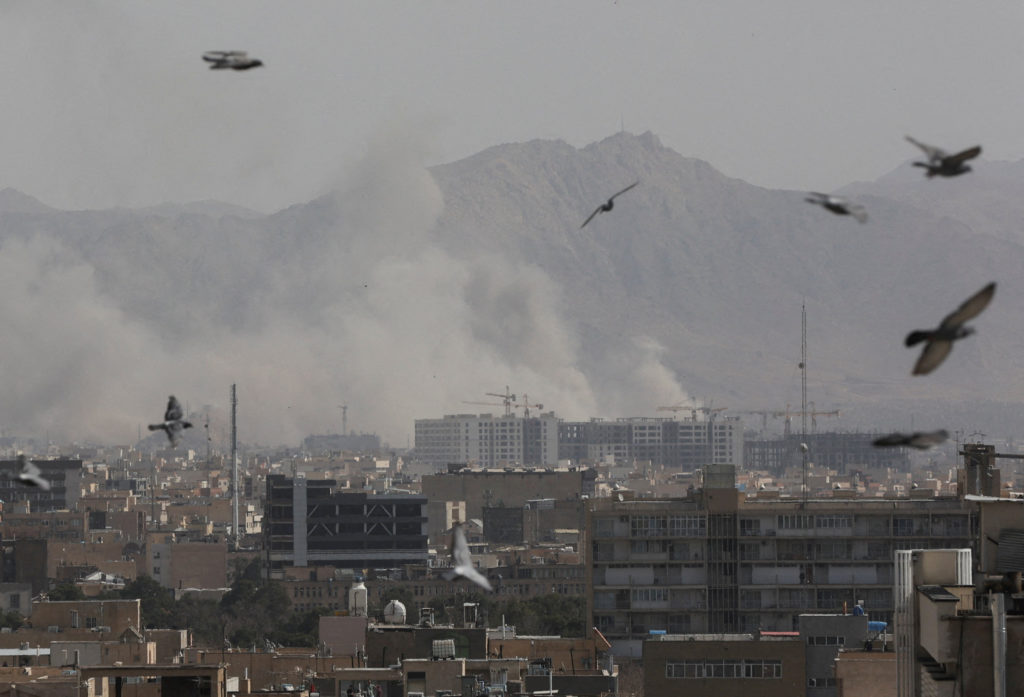
The confrontation of March-April 2026 pitting the United States and Israel against Iran marks a critical inflection point in the evolving Middle Eastern strategic landscape. The conflict has not only disrupted existing deterrence frameworks, but has also intersected with broader dynamics in energy geopolitics, great power competition, and the reconfiguration of regional alignments. This broad analysis examines the key operational, political, and strategic dimensions of the conflict, assessing its implications for the regional order and international security.
CONTEXT AND STRATEGIC DRIVERS
The outbreak of the war followed a convergence of strategic pressures rather than a single precipitating event. Within the U.S. national security establishment, hawkish factions had long advocated for more decisive action against Iran’s capabilities, particularly following the limited deterrence achieved by the June 2025 Israeli strikes. Pro-Israel lobbying intensified this pressure, while Israel itself pursued a months-long diplomatic effort to move Washington toward a more maximalist posture. However, beyond the immediate security calculus, the decision carried a decisive economic dimension. In the energy field, a core objective of the broader Trump administration strategy is to reshape the architecture of global oil transactions. Hence, constraining Iran’s ability to supply discounted crude to China is key to limiting Chinese industrial and military capacity. The parallel with the Venezuela pressure campaign was noted by multiple analysts as the campaign unfolded.
MILITARY STATE OF AFFAIRS
The U.S.-led campaign achieved significant conventional military objectives within a limited timeframe. The opening strikes eliminated the Supreme Leader and senior military commanders, and destroyed key Revolutionary Guards institutional compounds, including the main defence research headquarters. Iran’s air defence systems were substantially degraded, effectively ceding airspace control to U.S. and Israeli aircraft. The majority of Iran’s ballistic missile launchers were also torn down, and most of Iran’s mapped military-industrial sites were struck, while Iranian missile and drone attacks on Israel declined sharply by the second week. The main nuclear enrichment facilities were targeted, as in June 2025, and a significant number of Iranian warships were sunk.
Iran’s strategic posture, however, was never built primarily on conventional military forces. As analysts had long assessed, it rests on a mosaic of asymmetrical defence approaches, an interlocking network of drone swarms, proxy militias, naval harassment, and the latent threat of disrupting maritime traffic in the Strait of Hormuz and in Bab el-Mandeb. Therefore, the campaign neutralized the conventional layer, but left the asymmetric one largely intact.
THE CEASEFIRE
The ceasefire agreement brokered through Pakistani mediation has been widely described as ambiguous, with its full terms remaining undisclosed. As it stands, the arrangement leaves three critical gaps unaddressed.
First, the nuclear file, the central stated objective of both the Trump administration and its critics, sits entirely outside the agreement. No verified dismantlement measures or monitoring regime have been reported. Second, Iran’s ballistic missile capability, while severely degraded, has not been permanently neutralized. Its reconstitution depends more on resources than intent, and any sanctions relief associated with the ceasefire would effectively restart the rearmament timeline.
Third, at the proxy level, Hezbollah, the Houthis, and Iran-aligned factions in Iraq are already shifting into recovery mode. For these actors, the ceasefire constitutes a tactical pause rather than a strategic defeat.
IRAN
The discrepancy between Iran’s stated positions and its behavior is significant. Until his assassination in February 2026, former Supreme Leader Ali Khamenei had repeatedly ruled out negotiations with the U.S., while in March 2026 Iranian officials publicly insisted that any ceasefire required full deterrence guarantees and that no talks would proceed unless Israel halted its Lebanon operations. On the other hand, the Iranian delegation travelled to Islamabad and engaged in diplomatic talks, even as, on April 8, Israel carried out one of its largest single operations against Hezbollah in Lebanon, launching over 100 airstrikes across Beirut within ten minutes and causing more than 300 casualties, many of them civilians. This behavioral shift reflects the severity of the damage sustained during the U.S.-Israel campaign.
Iran has sustained significant losses across the institutional, military, and economic spectrum. More than 50 senior figures were killed, and the armed forces have been substantially degraded. The nuclear program has been set back, and the economy – already strained by decades of sanctions – has been pushed closer to structural collapse. Infrastructure damage is extensive, further compounding systemic vulnerabilities. The social contract between the regime and its citizens is under growing pressure, while internal power structures have also been affected as rival factions compete to shape the post-war political trajectory. Although the worst-case scenario of regime collapse has been averted, the conditions now facing the leadership bear little resemblance to those that prevailed prior to the conflict.
UNITED STATES
The current outcome of the war, at least so far, fits a pattern observable across multiple U.S. military engagements. In many major campaigns over recent decades, battlefield success has not translated into durable political outcomes. The 1983 U.S. withdrawal from Lebanon following the Beirut barracks bombing left a vacuum later filled by Hezbollah. The 2003 invasion of Iraq was executed with military precision but without a viable plan for post-conflict governance, creating conditions that later favored Iran-backed militias. Moreover, the 2011 U.S. withdrawal significantly weakened Iraqi institutional capacity, military deterrence, and state authority at a critical juncture, compounding governance failures and security vacuums that ISIS was able to exploit systematically, culminating in its strategic breakthrough by 2014. The 2013 Syria “red line” episode further undermined U.S. credibility at another pivotal moment. The 2021 withdrawal from Afghanistan, widely perceived as chaotic, sent signals of unreliability across theatres where the U.S. maintained partnerships. More recently, in May 2025, the ceasefire with the Houthis was framed by Washington as a success, even as the Houthis presented it differently, and it included no provisions addressing their continued strikes against Israel.
The structural driver of this pattern is the American domestic political architecture. U.S. foreign policy is not produced by a unified strategic will, but through the collision of competing institutional interests. The defence industry has institutional and financial incentives that favor escalation cycles over resolution. Oil and gas interests carry distinct and sometimes contradictory incentives depending on price dynamics. Bipartisan polarization ensures that policy associated with one administration becomes a target for the other. In the Iran campaign, this fragmentation is acute. MAGA isolationists opposed the war from the outset, pro-Israel constituencies wanted it extended, and traditional foreign policy establishments on both left and right consider the outcome incomplete. As midterm elections approach (November 2026), the economic impact of the campaign, elevated oil prices, and inflationary pressure create an electoral liability for the Republican Party. Historical patterns linking consumer prices to electoral outcomes translate these pressures into an incentive for disengagement. The result, as in comparable past episodes, is likely to be the same pressure for premature withdrawal of the U.S. that leaves the Iranian underlying strategic problems intact.
ISRAEL
Since the October 7 attacks, Israel has undergone a fundamental shift in security doctrine. The framework has moved from deterrence, or the credible threat of retaliation, to prevention or pre-emptive military action as the primary guarantor of security. Gaza was the first full-scale application of this doctrine. Its results exposed a core structural limitation, as overwhelming force can destroy infrastructure and eliminate leadership, but cannot produce sustained political control or prevent gradual reconstitution. Hamas’ military capacity was fractured and its leadership decimated, yet it has survived as a political actor. Israel maintains uncontested military dominance over Gaza but does not govern it.
The adapted doctrine now combines demilitarized buffer zones with efforts to keep hostile actors consumed by internal strife, and the maintenance of Israeli freedom of action through adjacent airspaces. The objective is not territorial occupation, but the prevention of coherent military threat reconstitution within proximity zones: a doctrine of permanent disruption.
Recent survey data in Israel presents a complex picture. Only around 22% of Israelis believe their country or the U.S. won the war, and only 32% express satisfaction with the overall outcome. At the same time, 79% support ongoing military operations in Lebanon. Prime Minister Netanyahu faces simultaneous pressure from military and political hardliners, who believe the ceasefire has left Israel more exposed, and from a reinvigorated opposition, which has characterized the strategy of permanent escalation without a political horizon as a formula for endless war.
The 2026 legislative elections in Israel are likely to sharpen these tensions. Political leaders will face constituency pressure for security guarantees rather than abstract strategic benchmarks. On that basis, continued military operations in Lebanon through sustained targeted strikes, intelligence operations, and demilitarized buffer zones, are a probable near-term trajectory, premised on full Hezbollah disarmament as the condition for settlement.
Whether Israel’s continued military presence in southern Lebanon signals a new phase of territorial expansion requires analytical scrutiny. Israel’s military stated objective is the establishment of security buffers, not the extension of sovereignty. Permanent annexation of southern Lebanese territory would place Israeli civilians closer to Hezbollah’s remaining capacity, which is the precise opposite of what the preventive doctrine stipulates. The historical record offers relevant context. Israel withdrew from Sinai in the 1980s, from southern Lebanon in 2000, and from Gaza in 2005. The Golan Heights stands as the single exception. It was formally annexed and subsequently recognized by the U.S. under Trump’s first term, following sustained pro-Israel lobbying in Washington, as a deliberate and long-term political investment that was never done for Gaza or southern Lebanon. Moreover, the broader “Greater Israel” concept has never materialized around a single agreed map, even within Israel’s hard-right constituencies.
LEBANON
The Nawaf Salam government, which took office in early 2025, marked the first Lebanese government in three decades to remove the “People, Army, and Resistance” formula from its ministerial statement, formally stripping Hezbollah of official political cover. The Lebanese Army began deploying south of the Litani River for the first time in decades. Hezbollah, severely weakened by the 2023–24 conflict with Israel and the killing of its senior leadership, appeared to be in a containment phase. However, the decision to join the March 2026 war and its military performance, made clear that Hezbollah had been consistently reconstituting and adapting after the ceasefire agreement of 27 November 2024, shifting toward a more dispersed, guerrilla-style posture. The group is now seeking to leverage the U.S. reversal on Iran to rebuild domestic legitimacy, to forestall any return to pre-war political arrangements, and to sideline political opponents through legal and parliamentary means. Potentially, it could also resort to the kind of targeted violence that characterized the 2005–2013 period. However, Lebanon’s consociational system, rooted in sectarian power-sharing, makes decisive action against any single actor structurally difficult.
The displacement crisis adds a compounding dimension. More than one million people, roughly one quarter of the population, have been displaced, the majority from communities affiliated with or dependent on Hezbollah. Israel has signaled it will prevent the return of these populations to southern Lebanon before full Hezbollah disarmament. Potential donor governments continue to condition reconstruction support on disarmament benchmarks that Hezbollah will not accept. Gulf governments are reluctant to finance a state in which Hezbollah retains structural power, and their own post-war economic conditions may limit their capacity for large-scale assistance. The result is a protracted humanitarian and political impasse structurally analogous to the Gaza situation: vertical division leading to heightened and potentially violent sectarian tension, no viable governance solution, and humanitarian needs unaddressed because of political conditionality.
REGIONAL ACTORS: TURKEY AND THE GULF COUNTRIES
A weakened Iran will create a strategic space that other actors are positioned to fill. Before the conflict, Turkey was already the dominant external actor in post-Assad Syria. Iran’s degradation has accelerated Ankara’s centrality to whatever regional order emerges in Syria, Iraq, and in the formation of Muslim political sentiment. This growing influence is placing Turkey on a direct collision course with Israel, particularly in Syria, where it holds more operational cards than any other external actor. This helps explain why Israeli officials have been increasingly explicit about viewing Turkey as an emerging strategic threat.
The GCC states have absorbed the most immediate economic shock from the conflict. The GCC social contract, the implicit exchange of prosperity for political loyalty, depends on a stable, interconnected regional economy and is under acute stress. Three simultaneous challenges now face the GCC states. The first is restoring confidence in the Gulf development model, which relies on predictable oil exports, secure transit routes, and sustained foreign direct investment. The second is calibrating policy toward a wounded but not broken Iran, where accommodation risks emboldening Tehran while confrontation risks triggering another cycle of economic disruption and infrastructure threats. The third is launching a rapid economic recovery program capable of absorbing the direct impact of the war, preserving fiscal stability, and maintaining the domestic social contract.
EUROPE
Throughout the conflict, European governments were largely absent from the strategic response. The U.S. response to Iran’s threat, which historically targeted not only U.S. but broader Western interests, proceeded without coordinated European engagement. This absence has been considered by analysts to be a significant strategic error. An Iran whose nuclear program remains intact, operating alongside Gulf economies under sustained economic pressure, represents a security and economic risk that extends well beyond the scope of U.S. or GCC interests. By declining to join or support the effort to limit Iran’s capabilities, and by failing to develop credible alternatives or protect the GCC’s economic space through coordinated action, European actors have contributed to a balance of power in which Iran’s residual leverage may grow, deterrence continues to erode, and the cost of eventual confrontation is higher than it would otherwise have been.
OUTLOOK OF THE CONFLICT
Iran’s remaining asymmetric capabilities will not remain dormant during the next phase. In the absence of significant breakthroughs in the negotiations, the U.S. and Israel retain strong strategic incentives to maintain a pattern of targeted operations to disrupt Iranian nuclear and ballistic rearmament, degrade surviving proxy infrastructure, and signal through action that the cost of reconstitution will remain high. Grey-zone operations (precision strikes, cyber disruption, intelligence operations) have proven more durable in their effects than large-scale military campaigns, precisely because they deny adversaries the stable environment needed to rebuild. All parties, including the GCC, face prohibitive costs from a return to full-scale confrontation. Therefore, the dominant near-term posture across all regional actors is likely to be the advancement of interests through low-intensity confrontation, back-channel pressure, and strategic ambiguity.
A settlement that resolves the nuclear and ballistic files, constrains Iran’s proxy network, and produces a stable, enforceable regional scenario would materially change the strategic equation. However, on current evidence, this is the least probable outcome. It would require a level of sustained U.S. political investment that Washington has consistently failed to deliver after military campaigns. It would also require Iran’s post-war leadership to make concessions that its predecessor explicitly refused, and that any successor government would face existential domestic pressure to resist. Finally, it would require a Hezbollah willing to disarm as a condition for Lebanon’s recovery.